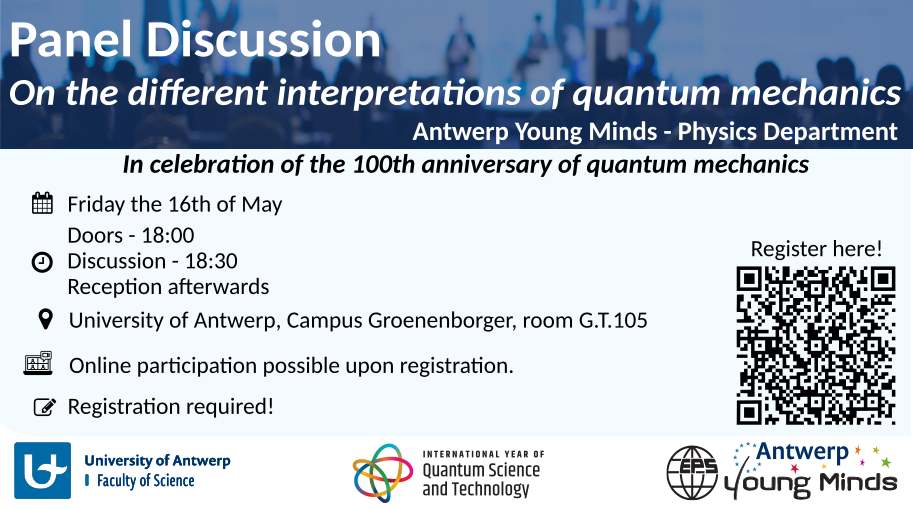
The quantum theory has known a very successful first 100 years in terms of describing various phenomena and predicting new ones. The math behind it is solid and new technological advancements are leading a second quantum revolution. However, despite the numerous successes, some fundamental questions remain open:
- What is the nature of the wave function?
- What are the physics of a wave function collapse in a measurement process?
- Why do we experience the world so classically and how far can we push quantum effects?
- What about the alternative interpretations in quantum mechanics?
While important, these questions are usually only discussed briefly in the usual physics curriculum, if discussed at all. Therefore, in light of the 100th anniversary, the Antwerp Young Minds will be organising a panel discussion around these fundamental questions. Several experts will be given the stage to discuss various interpretations and open problems in a moderated debate. The panel members are:
- Hans De Raedt (University of Groningen) is a computational physicist specialized in simulating quantum systems on classical computers. His work includes alternative explanations for violations of Bell inequalities.
- Ward Struyve (KU Leuven and University of Antwerp) is a physicist and philosopher of physics. He worked on Bohmian mechanics in the context of relativistic physics and quantum cosmology and the problem of arrival times in quantum mechanics.
- Pieter Thyssen (UC Liège) is a philosopher of science who focused on the study of Einstein’s block universe and the philosophy of chemistry.
- Jacques Tempere (University of Antwerp) has a broad interest in quantum many body physics, in particular on the description of these complex systems with path integrals.
- Dirk Van Dyck (University of Antwerp) is an expert in electron microscopy who in particular has expertise in statistical methods at the quantum level.
- Franck Laloë (Kastler-Brossel Laboratory, Paris): is a physicist known for his quantum mechanics textbook and he has done work on spontaneous (wave function) collapse theories, as well as on the pilot-wave theory of quantum mechanics.
Practical details:
- Time: Friday the 16th of May, 18h doors, 18h30 discussion. Reception afterwards.
- Place: Universiteit Antwerpen, Campus Groenenborger, room G.T.105.
- Online meeting possible as well. (Link per mail after registering.)
Registration via the following form is required: https://forms.office.com/e/rDgGFAGk7B.
You can also submit questions there.